Elizabeth Glander
2nd Year
WUDPAC
Supervised by Mina Porell
Associate Paintings Conservator for Winterthur Museum, Garden & Library,
Affiliated Associate Professor, Department of Art Conservation, University of Delaware
2nd Year Seminars
During second year, majors have weekly seminars to learn more about historical and current treatments specific to their area of focus. Below is a list and brief summary of the seminars for fall 2025.
-
Consolidation & Facing
-
Reviewed why layers of the painting may flake or delaminate, factors to consider when consolidating, how to choose a consolidant, historical approaches, methods of consolidation, and facing.
-
-
Controlled Humidification
-
Learned how the layers of the painting respond to moisture, factors to consider when humidifying a painting, and methods of humidification. I also attended the humidification seminar for paper majors to learn about how they use humidification.
-
-
Surface Cleaning & Varnish Removal
-
Learned about and practiced the Modular Cleaning Program (MCP), how to conduct solubility testing, how varnishes degrade over time, and the solvents used to remove or reduce varnishes.
-
-
Adhesive Supports
-
This seminar was led by textiles and paper, however it was useful to share information pertaining to different types of adhesive supports. We practiced applying different adhesives onto textile and paper substrates that could then be reactivated to support tears and losses.
-
-
Tear Repair
-
Learned about historical and current techniques for repairing tears (patches, linings, and thread-by-thread tear mending), the adhesives used, and had an introduction of the physics of tears and mends.
-
-
Lining Techniques
-
Learned about and had hands-on experience for historical lining techniques, reviewed historical and current adhesives used, how linings effect the painting, considered the benefits and disadvantages of lining, and discussed lining alternatives.
-
-
Hydrogels
-
Matt Cushman (George F. & Sybil H. Fuller Conservator in Charge, Worcester Art Museum) and Michelle Sullivan (Associate Conservator of Paper, J. Paul Getty Museum) led this three-day seminar on hydrogels. We learned about their properties, uses, and the hands-on portion included making and testing the gels on different materials.
-
-
Varnishing
-
Reviewed the purpose of varnishes, historical and synthetic varnishes, discussed when to apply or not apply a varnish, and how to apply varnishes.
-
-
Filling
-
Learned about different fill materials, how to texture a fill, application methods, and had hands-on experience with the different types of fills and application methods.
-
-
Inpainting
-
Reviewed the history of retouching, historical and current materials used, the ethics of inpainting, and had a hands-on experience using different inpainting materials. The paper and photo majors joined this seminar to share their experiences with inpainting.
-

Testing different gels to clean a study collection painting.
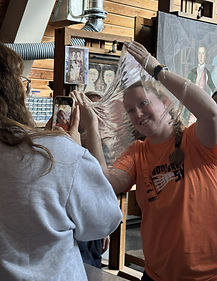
Showing off a large hydrogel that was cast out between two sheets of Mylar.
Image Credit: Sarah Purnell

Discussing with paper majors the steps to humidify a large rolled paper map.
Image Credit: Karissa Muratore

Using MCP to remove surface grime on a study collection painting.

Edge lining mock up.
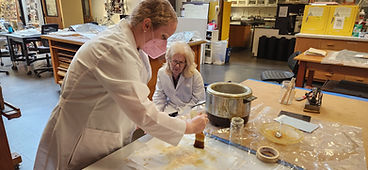
Dr. Joyce Hill Stoner instructing me on how to complete a wax resin lining.
Image Credit: Mina Porell

Setting up the hot table to complete mock ups of BEVA and wax resin lining.

Creating a silicone mold for a textured fill.