Elizabeth Glander
2023-2024
ICA - Art Conservation
Supervised by Andrea Chevalier and Wendy Partridge
Andrea is the Director of Conservation & Head of Paintings Conservation
Wendy is a Paintings Conservator
Lecture Chart 2
Archibald Willard
c. 1870s
Distemper (est.) on canvas
11 ft x 13 ft (H x W)
Spirit of '76 Museum

BT recto
Image Credit: ICA

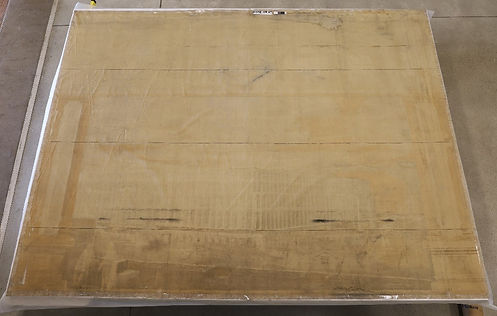
BT verso
Image Credit: ICA
ICA - Art Conservation was contracted by the Spirit of '76 Museum to treat a lecture chart by Archibald Willard (1836-1918). The lecture chart was commissioned by the Free Masons in Wellington, OH in the 1870s and is one of three charts in the museum. The lecture chart was used to impart Masonic teachings. It is unknown how it was originally displayed, however, puncture holes along the top of the lecture chart suggests that it was likely hung at some time. After discussion with the museum, it was decided that no loss compensation or inpainting would be undertaken because of financial reasons.
This treatment was supervised by Andrea Chevalier, Director of Conservation and Head of Paintings Conservation, and Wendy Partridge, Painting Conservator. Andrea wrote the condition report, treatment proposal, and treatment report. I assisted with editing the treatment report to include images of my work. There were some elements of this treatment that I could not perform because I did not have appropriate personal protective equipment (PPE).

Archibald MacNeal Willard (1836-1918)
Willard was born in Bedford, OH on August 22, 1836. Upon moving to Wellington, OH in 1855, he taught himself how to draw. Then in the early 1860's, he was an apprentice to a local decorative artist and wagonmaker. Willard enlisted in the 86th Ohio Volunteer Infantry in 1863 and served until February 1864. Upon returning to Wellington, Willard started painting again and became a popular artist. In 1876, he produced his most recognized painting, Spirit of '76. Willard died on October 11, 1918.
Case Western Reserve University. n.d. "Willard, Archibald MacNeal." Accessed December 14, 2025. https://case.edu/ech/articles/w/willard-archibald-macneal.
Archibald MacNeal Willard (1836-1918)
Image Credit: Wikipedia
Summary of Treatment
-
Dry surface cleaned.
-
Humidification of creases.
-
Reinforce tears and holes with rayon tissue coated with BEVA 371.
-
Consolidate friable paint (I did not complete this because I did not have appropriate PPE).
-
Edge lining with PeCap coated with BEVA 371.
-
Stretched onto wooden strainer with Coroplast panels.
Surface Cleaning


Left is before surface cleaning. Right is after surface cleaning.

About 8 feet of the mural was unrolled face up for surface cleaning. A grid system was used to keep track of where surface cleaning had been performed.
Humidification

Dry blotters with Plexi and weights on top of the painting to help relax creases.
Reinforcing Tears and Holes

Mending tears and holes with rayon tissue coated with BEVA 371.
Image Credit: Wendy Partridge
Consolidation and Edge Lining Preparation
To consolidate the friable paint, a 2% solution of Paraloid B72 in ethanol was used. Five coats were sprayed onto the surface of the painting by Andrea and Wendy with each coat allowed to dry before the next layer was applied. Then PeCap 7-330 fabric was prepared with five coats of BEVA 371, diluted 1:1 with benzine. Each layer was rolled onto the PeCap with a paint roller and allowed to dry before additional layers were applied. Because I did not have appropriate PPE, I did not participate in these step.
Edge Lining

Placing the PeCap strips for edge lining.

Corner, before it was heat set.

Corner, after it was heat set.
After Treatment
A wooden strainer with Coroplast panels was constructed to support the mural. The disassembled strainer and mural were transported to the museum to be reassembled and stretched inside. I had moved to another internship at this point and did not participate.

AT recto
Image Credit: ICA
AT verso
Image Credit: ICA

AT strainer with Coroplast panels.
Image Credit: ICA