Elizabeth Glander
2nd Year
WUDPAC
Supervised by Mina Porell
Associate Paintings Conservator for Winterthur Museum, Garden & Library,
Affiliated Associate Professor, Department of Art Conservation, University of Delaware


Summary of Treatment
Completed Treatment
-
Dry surface cleaned.
-
Applied PeCap coated with BEVA film to areas of loss in the upper left corner.
-
Performed solubility tests to remove surface grime, varnish, overpaint, and patch adhesive.
-
Thread-by-thread tear mending, using the “beetle” technique, for losses on the lower turnover edge.
-
Edge lining lower tacking margin and secured to stretcher.
-
Removed patches and thread-by-thread tear mending.
-
Aqueous surface cleaned.
-
Varnish removal is about half way complete.
Next Treatment Steps
-
Finish varnish and overpaint removal.
-
Local humidification for planar distortions.
-
Apply isolating varnish layer.
-
Apply fills and inpaint.
Condition Summary
For a complete condition report of the painting, please click on the pink button above.

Condition map of the painting, recto.
Red = Area of loss
Orange = Abrasion
Yellow = Tear Light
Green = Inpainting/over painting
Dark Green = Insert and over paint
Light Blue = Cusping
Pink = Impact damage
White = Possible inclusions in the paint layer that are small and rounded

Condition map of the painting, verso.
Orange = Abrasion
Light Blue = Fill
Light Green = Felt adhered to stretcher
Purple = Adhesive and felt residue from being removed
Losses in the Canvas
Because the painting has not been removed from its stretcher, I did not to remove it from the stretcher to reinforce losses in the canvas.
There were two holes near the upper left corner on the turn over edge. To reinforce them, BEVA film coated PeCap was slipped in between the canvas and the stretcher. The photos below demonstrate how this was completed.
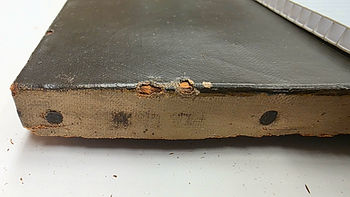
Losses before treatment.

PeCab fabric with BEVA film applied to it. Black linen carpet thread had been sewn through the bottom.

Using the carpet thread to pull the PeCap fabric into place.

Using thin wire to pull linen carpet thread in between the tacking margin and stretcher.

Using thin wire to pull the linen carpet thread through the holes in the canvas.

After the PeCap had been positioned. It was set with a heated spatula.

Losses after treatment.
Solubility Testing
Solubility testing was completed to determine the best way for removing surface grime. Initially, deionized (DI) water and then saliva with a DI water clear was used. Grime was not removed with either of these. The Modular Cleaning Program (MCP) was then used. It was determined that a pH 8.5 solution of citric acid, bicine, and DI water (1:1:3) removed surface grime. Two small sections of the painting was cleaned to perform varnish solubility testing.
Solubility testing was completed to determine the best way for removing varnish. Testing began with 1:3 isopropanol:ShellSol D38 solution and continued to 3:1 isopropanol:ShellShol D38 solution. The varnish was not removed and testing continued to solutions of acetone and ShellSol D38. 2:1 acetone:ShellSol D38 successfully removed the varnish.

Solubility testing for varnish removal.

Solubility testing for varnish removal.
Stabilizing the Lower Tacking Margin


A temporary member was created using Coroplast, Volara, and Tycore board. Hot glue was used to attach the elements together. The temporary member was secured to the stretcher with screws.

Humidity chamber helped relax the canvas of the lower tacking margin prior to removing the member.

Stretcher member removed, before removing dust and insect remains.

Blotter covering the tacking margin was it dries.
"Beetle" Technique of Thread-By-Thread Tear Mending
To address the three losses on the turnover edge, I used a thread-by-thread tear mending technique referred to as the "beetle" technique. Petra Demuth created this method of applying a canvas insert to a loss based off of Winfried Heiber's thread-by-thread tear mending technique.
With this technique, a new piece of canvas with a similar thread count is decrimped three times and sized with 8% methyl cellulose. It is then cut to be larger than the loss in the painting. Excess threads are removed until the shape of the insert matches the loss. The insert is positioned in the loss and every other thread is positioned on either side of the painting.
I began to attached the new threads from the back of the painting using 9:1 Lineco:5% methyl cellulose adhesive. Every other thread was adhered to the canvas. It is important that the ends of these threads are not in a straight line with each other to reduce stresses to the canvas. The remaining threads were cut and attached to the original canvas using a butt joint.


Steps used for the "beetle" technique for an insert.
Patch Removal & Thread-By-Thread Tear Mending


The patch adhesive swelled with water. To remove the patch, a small amount of water was brushed onto the adhesive, allowed to swell, and then the patch was gently peeled away. Once the patch was removed, the fills were also removed by softening them with water and then mechanically removing them. Any remaining adhesive was swelled with Xanthan Gum:Konjac Glucomannas:2% Agar (XKA) hydrogel and then mechanically removed.
The loss in the canvas was mended with the same "beetle" thread-by-thread tear mending technique. The compound tear was mended with thread-by-thread tear mending and 9:1 Lineco:5% methyl cellulose.
Progression of removing the patches and tear mending.
Varnish Removal
Surface grime was removed with 1:1:3 pH 8.5 bicine:citric acid:deionized water solution and then cleared with 1000µS pH8.5 adjusted water.
Varnish was initially removed with 2:1 acetone:ShellSol D38. Once I was more comfortable with how the varnish was removed, I used 3:1 acetone:ShellSol D38. There is likely a natural resin varnish (est.) under the synthetic varnish. Varnish removal was not completed because the school year ended.


During treatment partial varnish removal. Normal light photo (left) and UV photo (right).
References
“Archives of Maryland, Volume 0565, Page 0457 - Matchett’s Baltimore Director for 1855-56.” Accessed March 11, 2025. https://msa.maryland.gov/megafile/msa/speccol/sc2900/sc2908/000001/000565/html/am565--457.html.
Fair, Lauren, Mary McGinn, and Lisa Clifford. 2025 (updated). “Winterthur X-ray Procedure Manual: User guide for Winterthur’s Pantak-Seifert X-ray equipment and Rhythm software.”
Hellier, Henry R. 1863. “E. M. Cross & Co.’s Baltimore City Business Directory, 1863-1864.” Baltimore: E. M. Cross & Co.
John W. Woods. 1860. “Woods’ Baltimore City Directory, Containing a Corrected Engraved Map of the City, a Business Directory, a Street Directory, Compiled expressly for this Edition; and an Appendix of Much Useful Information.” Baltimore: John W. Woods. https://archive.org/details/woodsbaltimoreci1860balt/page/n75/mode/2up.
Karraker, D. Gene. 2009. Looking at European Frames: A Guide to Terms, Styles, and Techniques. Los Angeles: The J. Paul Getty Museum.
Katlan, Alexander W. 1987. American Artists’ Materials Suppliers Directory, Nineteenth Century. Park Ridge, New Jersy: Noyes Press.
Katlan, Alexander W. 1992. American Artists’ Materials: A Guide to Stretchers, Panels, Millboards, and Stencil Marks. Vol. 2. Madison, Connecticut: Sound View Press.
Maryland Center for History and Culture. 1956. “Henry Bebie (Hans Heinrich Bebie) 1800?-1888: Portrait and Genre Painter of Baltimore.” Registration Files, Maryland Center for History and Culture.
Maryland State Archives. 2025. “Matchett’s Baltimore Director For 1855-56.” Accessed March 11, 2025. https://msa.maryland.gov/megafile/msa/speccol/sc2900/sc2908/000001/000565/html/am565--457.html.
Maryland State Archives. “Information on CE42 – (Death Record, Index).” Accessed March 11, 2025. https://guide.msa.maryland.gov/pages/series.aspx?action=viewSeries&ID=CE42.
Matchett, Richard J. 1851. “Matchett’s Baltimore Director for 1851, containing the Names, Dwellings and Occupations of the Householders, an Engraved Map of the City, Designating the Wards, with References to Public Buildings.” Baltimore: Richard J. Matchett. https://archive.org/details/matchettsbaltimo1851balt/page/n13/mode/2up.
Merrill, Peter C. 1997. “German Immigrant Artists in America: A Biographical Dictionary.” Lanham: The Scarecrow Press, Inc.
Sheriff, B. R. 1888. “R. L. Polk & Co’s Baltimore City Directory for 1888.” Baltimore: R. L. Polk & Co. https://archive.org/details/rlpolkcosbaltimo1888rlpo/page/n29/mode/2up.
The Baltimore Sun. “Article Clipped from The Baltimore Sun.” June 2, 1956. https://www.newspapers.com/article/the-baltimore-sun/50099375/.
Winterthur Library. 2005. “2005.0192, Looking Glass.” Winterthur Decorative Arts Photographic Collection Online Resource. Last revised June 23, 2005.
Winterthur Decorative Arts Photographic Collection Online Resource. “SeeDAPC Index.” Accessed March 6, 2025. http://dapc.winterthur.org/iseedapc/obj_dat/2005.0192.htm.
Winterthur Museum, Garden & Library. 2025. “2024.0019 A, Painting (Portrait).” Search the Winterthur Museum Collections. Last updated April 28, 2025Accessed March 10, 2025. http://museumcollection.winterthur.org/single-record.php?resultsperpage=20&view=catalog&srchtype=advanced&hasImage=&ObjObjectName=&CreOrigin=NOrth%20America&Earliest=&Latest=&CreCreatorLocal_tab=&materialsearch=&ObjObjectID=&ObjCategory=&DesMaterial_tab=&DesTechnique_tab=&AccCreditLineLocal=&CreMarkSignature=&recid=2024.0019%20A&srchfld=&srchtxt=&id=9bfa&rownum=44281&version=100&src=results-imagelink.
Wood, John W. 1870. “Woods’s Baltimore City Directory, Containing a Corrected Engraved Map of the City, a Business Directory, a Street Directory, and an Appendix of much Useful Information.” Baltimore: John W. Woods. https://archive.org/details/woodsbaltimoreci1870balt/page/774/mode/2up.
Young, Christina, and Alexander W. Katlan. 2021. “History of fabric supports.” In Conservation of Easel Paintings, 117-147. Joyce Hill Stoner and Rebecca Rushfield, eds. 2nd ed. New York: Routledge.