Elizabeth Glander
Oddy Test Research
Supervised by Dr. Peter Tandler
Associate Professor of Chemistry, Walsh University

Summary of Research
-
Can a procedure be created so that small museums could use it without expensive glassware (Mason jars instead) or strong chemicals for cleaning (Alocnox lab soap as the alternative)?
-
Can the time in the oven be reduced to 14-days instead of 28-days?
-
Can using gas chromatography-mass spectrometry (GC-MS) detect what compounds may be causing temporary pass or unsuitable ratings of the coupons?
The Oddy Test

William Andrew Oddy
Image Credit: https://www.wandrewoddy.com/
William Andrew Oddy (1942-present) was a conservation scientist at the British Museum in the 1970s. He was aware that almost everything in the world produces gases. Oddy wanted to create a way of evaluating whether materials were safe around metal objects in a collection (AIC Wiki 2023). He created an accelerated corrosion test which evaluates the effects of a material's off gassing on metal artifacts (Thickett and Lee 2004, 111). This test was coined the Oddy test after Oddy published a paper in 1973 describing the procedures.
The Oddy test has been modified, evaluated, and refined over the years by many scientists and museums. A 1993 study by Green and Thickett and a 2014 survey by Torok and Wickens concluded that there are many variations of completing the Oddy test (AIC Wiki 2023). The Metropolitan Museum of Art has been one of several museums performing research to not only create a standard set of procedures, but also a less subjective way to evaluate results.
Oddy Test Procedure
The Oddy test is a simple procedure resulting in it being used by cultural institutions ranging from small museums to national institutions. Because of this wide range of people completing the Oddy test, the procedure has been adapted by the person running it to use the materials at their disposal and their expertise. A sample material is sealed within a reaction vessel with metal coupons (copper, silver, and lead) and water and is placed within a 60C oven for 28-days. After that time, visual observations are used to determine whether or not the sample material's gases have caused a reaction and if the material is safe to be used around metal collection objects (Tennent, Green,Thickett 1993)
Silicone Stopper
Cu Coupon
Large Test Tube
Label
Small Test Tube
~2 g Sample
1mL RO Water

One method for setting up a reaction vessel.
Coupon Ratings
At the end of the Oddy test, coupons are assigned a rating of pass, temporary pass, or unsuitable. This indicates how the corresponding sample material may or may not be used around the collection.
Pass

-
No change.
-
May use for extended periods of time around collection items.
Temporary Pass

-
Slight corrosion and/or discoloration.
-
May use for a short period of time around collection items.
Unsuitable

-
Obvious corrosion and/or major discoloration.
-
Never use around collection items.
Concerns
There are some commonly stated concerns pertaining to the Oddy test.
First, there are reproducibility problems with the test. The two coupons below show results for the same kind of hot glue, but for two different Oddy tests. The left coupon received an unsuitable rating while the right coupon received a pass rating.

Reproducibility concerns - Cu coupons testing the same kind of glue.
Second, the results for the Oddy test are also subjective. The two coupons below both received temporary pass ratings.

Subjectivity concerns - Cu coupons both with temporary pass ratings.
Third, the Oddy test does not show or indicate what chemicals are causing discoloration or corrosion on the metal coupons.
My Research
My research first began by trying to create a procedure that small museums could use without expensive glassware (Mason jars) or strong chemicals for cleaning (Alocnox lab soap). Part of this research also investigated if the time in the oven could be reduced in an effort to produce results more quickly. There is research by Wang et al. (2011) showing that 14-days in a 60C oven is enough time to get results. They state that while more corrosion occurs on the coupons after 28-days, 14-days in the oven produced slightly less corrosion, but with the same final ratings. However, the coupons need to be scrutinized more critically when in the oven for only 14-days.
Throughout the year, my research shifted to using gas chromatography-mass spectrometry (GC-MS) to try and detect what compounds may be causing temporary pass or unsuitable ratings of the coupons. Upon graduating, Dr. Tandler asked me to be his research assistant to continue researching the Oddy test. During this time, I used Pyro and Headspace GC-MS. In 2023, Dr. Tandler and I attended Pittcon Conference and Exposition where I gave an oral presentation titled What can Damage Museum Collections: Using Headspace & Pyrolysis GC-MS to Identify Harmful Materials.
As of March, 2023, I had completed 22 different Oddy tests including five different configurations of the reaction vessel. The 22 different tests contained a total of 354 reaction vessels. One of the 22 tests was in the oven for the standard 28-days while the other 21 tests were in the oven for 14-days.
Sample Selection
There is a searchable database of Oddy test results on the AIC Wiki. From this database, I selected my control materials as well as 3M hot glues.
-
Negative control = Mylar
-
Positive control = Titebond III Ultimate wood glue
-
Blank = no sample
-
3M hot glue 3762 = inconsistent results reported
-
3M hot glue 3748 = reported once
-
3M hot glue 3747 = had not been reported as of March 2023
Composition of 3M hot glues
3762 hot glue

3748 hot glue

3747 hot glue

Versions of Oddy Test


The first version of the Oddy test reaction vessel I used. If included a mason jar, a glass rod that I bent into a custom coupon stand, and a Cu coupon.

The second version of the Oddy test reaction vessel I used. It included glass test tubes and silicone stoppers with a slit cut into it to hold the copper coupon. Electrical tape was used to help keep the stoppers from popping out, however, it was not successful.

The third version of the Oddy test reaction vessel I used. A custom made wooden stopper support was created and held in place with wing nuts and screws. The large beakers were used to help support the test tubes while in the oven.

This is a completed Oddy test while the copper coupons were being assessed and assigned ratings.
Oddy Test Results


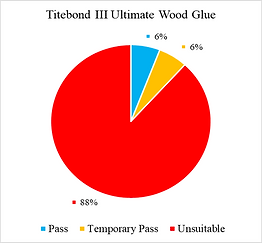
Mylar and the blank controls have almost identical results indicating that Mylar was a good choice for the negative control. The variation of the experimental design, such as my cleaning procedure and setup may have contributed to not always getting a pass rating. The wood glue was an excellent choice for a positive control because it almost always received an unsuitable rating.


This shows that my Oddy tests had inconsistent results for all three of the hot glues.
Improvements & Alternatives
Research has been conducted to address concerns with the Oddy test or to find an alternative method of determining if a material may cause harm to a collection. These include:
-
Different cleaning procedures to address the impurities in the metal used for the coupons.
-
Different reaction vessel setups; originally rubber stoppers were used, but then the stoppers were switched to silicone. However, the silicone may be introducing something which affects the results.
-
Technology has been used to help assist with coupon ratings to help eliminate the subjectiveness.
-
Analytical instruments are being used to help identify harmful compounds in materials.
Analytical Instrumental Methods
I primarily used gas chromatography - mass spectrometry (GC-MS) with two different sample introduction methods. Headspace was used to emulate the Oddy test environment and to sample the gas above the sample material. Flash pyrolysis vaporized the sample into a gas.
In headspace GC-MS, heating the sample causes the volatile molecules to move into the gas phase (referred to as the headspace phase). A sample of this volatile gas is collected in the presence of oxygen.

Diagram of Headspace GC-MS.

Headspace oven was at 60C. The GC oven started at 60C and increased to 250C at a rate of 12.5C per minute.
This is a chromatogram for the wood glue and Mylar at 60C. Mylar showed no significant peaks. The wood glue has two regions of peaks. Small oxygenated molecules come out in the first couple of minutes and butoxyethoxy ethanol comes out later. In the enlarged chromatogram, we see t-butyl alcohol, acetic acid, and n-butanol. Acetic acid can cause tarnish and corrosion on metal objects.

This is a chromatogram of the three different hot glues with Mylar and wood glue for comparison. All three of the hot glues have significantly more peaks than the wood glue, but there are still two regions of peaks. In the first two to three minutes, the smaller gaseous oxygenated molecules come out. Then after about five minutes, aromatic and aliphatic molecules come out. We were not able to identify specific aromatic or aliphatic molecules. Both the 3747 and 3762 hot glues had peaks for acetic acid, which makes sense because they both contain ethylene vinyl acetate polymer. We were not able to identify if 3748 had a peak for acetic acid because of peak resolution. In comparing the different glues, wood glue has acetic acid as a major headspace constituent. The complex gaseous profile of the hot glues may indicate that the other molecules are competing for surface binding on the coupon.
In Flash Pyrolysis GC-MS, the sample is dropped into the pyrolyzer furnace and heated very quickly to the gas phase in the presence of nitrogen. This is then transferred to the GC-MS for analysis.

Diagram of Flash Pyrolysis GC-MS.
Image Credit: Frontier Lab

The pyrolyzer furnace was at 115C. The GC oven started at 40C and increased to 280C at a rate of 12C per minute.
This is a chromatogram for wood glue and Mylar. The Mylar had no significant peaks. The rise at about 19 minutes is the temperature increase in the instrument. Wood glue did have a peak for acetic acid, butoxyethoxy ethanol, and butoxyethoxyethyl acetate.
This chromatogram is for the three different hot glues with Mylar and wood glue for comparison. There are no oxygenated compounds because flash pyrolysis is done in the presence of nitrogen. Also, the sample was vaporized, so only the large compounds are coming out. Similar to headspace, the hot glues have more complex chromatograms and we are seeing the aromatics and aliphatics. 3762 hot glue has the most aromatics and aliphatics. These results complement the headspace results and we believe that the aromatics and aliphatics are acting as a protectant for the metal coupon surface.

Closing Remarks
Hot glues 3747 and 3762 have the potential to make acetic acid because they both contain ethylene vinyl acetate, which we confirmed in headspace. It makes sense that 3762 has a higher pass rate because it contains the most aromatics and aliphatics, which we saw in flash pyrolysis.
Headspace GC-MS has provided a good representation of compounds in a sample's off gassing during the Oddy test, even though we are not really seeing small compounds. Flash pyrolysis has been beneficial for assessing the large compounds in the samples. Moving forward, using a porous layer open tubular (PLOT) column in the GC-MS will help to identify the smaller compounds. I do want to stress that we used a small sample size, so we would like to increase the sample size to determine if what we are proposing does occur. There may never be perfect materials available for displaying metal objects. However, when it comes time to choosing materials for this purpose, it may mean that knowing what compounds are in the materials and how they will interact with the object will be extremely beneficial.

References
3M Safety Data Sheet 3762. https://multimedia.3m.com/mws/mediawebserver?mwsId=SSSSSuUn_zu8l00x482UN8mU5v70k17zHvu9lxtD7SSSSSS-- (accessed Mar 9, 2023).
3M Safety Data Sheet 3748. https://multimedia.3m.com/mws/mediawebserver?mwsId=SSSSSuUn_zu8l00xlY_BNxtx4v70k17zHvu9lxtD7SSSSSS-- (accessed Mar 9, 2023).
3M Safety Data Sheet 3747. https://multimedia.3m.com/mws/mediawebserver?mwsId=SSSSSuUn_zu8l00x4x_Um8_e5v70k17zHvu9lxtD7SSSSSS-- (accessed Mar 9, 2023).
AIC Combined Materials Testing Results. https://www.conservation-wiki.com/wiki/Combined_Materials_Testing_Results (accessed Mar 9, 2023).
AIC Conservation Terminology. https://www.culturalheritage.org/about-conservation/what-is-conservation/definitions (accessed Mar 9, 2023).
AIC Oddy Test. https://www.conservation-wiki.com/wiki/Oddy_Test (accessed Mar 9, 2023).
AIC Oddy Test Protocols. https://www.conservation-wiki.com/wiki/Oddy_Test_Protocols (accessed Mar 9, 2023).
CAMEO Mylar. https://cameo.mfa.org/wiki/Mylar (accessed Mar 9, 2023).
Frontier Lab. www.frontierlab.com. https://www.frontier-lab.com/assets/file/products/PY-3030D_E.pdf (accessed Mar 10, 2023).
Hatchfield, P.B. Pollutants in the Museum Environment: Practical Strategies for Problem Solving in Design, Exhibition and Storage; Archetype Publications: London, 2002; p 21.
MACC What is Art Conservation? https://preserveart.org/education/what_is_conservation/ (accessed Mar 9, 2023).
Shimadzu Academic Grant. https://www.ssi.shimadzu.com/about/shimadzu-academic-program.html (accessed Mar 19, 2023).
Tennent, N.H.; Green, L.R.; Thickett, D. "Interlaboratory Comparison of the Oddy Test.” Conservation Science in the UK, 1993.
Thickett, D. and Lee, L.R. Selection of Materials for the Storage or Display of Museum Objects. Br. Mus. Occ. Paper. 2004.
Tipler, A. An Introduction to Headspace Sampling in Gas Chromatography, Fundamentals and Theory. https://resources.perkinelmer.com/lab-solutions/resources/docs/gde_intro_to_headspace.pdf (accessed February 21, 2023).
Wang, S. et al. An Improved Oddy Test Using Metal Films.” Stu. Con. 2011, 56, 138-153.
Ward, P. The Nature of Conservation: A Race Against Time; The Getty Conservation Institute: Los Angeles, 1986.