Elizabeth Glander
Technical Analysis
Supervised by Catherine Matsen
Senior Scientist at Winterthur Museum, Gardens & Library,
Affiliated Associate Professor, Department of Art Conservation, University of Delaware
Illuminating the Layers: A Technical Analysis of Mary Elizabeth Price's Flower Border II
For my second year science project, I am completing a technical analysis of Mary Elizabeth Price's Flower Border II. This painting is in the collection of the Michener Art Museum. They will open an exhibit on Mary Elizabeth Price beginning Fall 2027. Click the button below to view my science proposal for this technical analysis.
Mary Elizabeth Price

Mary Elizabeth Price
Photograph, date unknown.
Image Credit: Wikipedia
Mary Elizabeth Price (1877-1965) was born in West Virgina before her Quaker family moved to Solebury (Bucks County), PA (Cathrine Martin Galleries n.d.; Talbott and Sydney 1998, 157). From c. 1896-1904, Price attended the Pennsylvania School of Industrial Arts followed by the Pennsylvania Academy of the Fine Arts from 1904-1907 (Talbott and Sydney 1998, 157).
Price moved to New York City in 1917 and began assisting with the Baby Art School, a pioneering program funded by Mrs. Gertrude Vanderbilt. In this program, public school children learned how to draw, paint, sculpt, create pottery, and carve wood. The Carnegie Institute of Technology in Pittsburgh, PA asked Price to stage an exhibit of local Pittsburgh children’s art work from 1919-1920 as an art education campaign for teachers and supervisors in art (My Daily Art Display n.d.).
In the mid-1920s, Price moved to a cottage she named the Pumpkin Seed Cottage (Pumpkinseed Cottage) which was located on the banks of the Delaware Canal in New Hope, PA (Jim’s of Lambertville n.d.; My Daily Art Display n.d.). At the Pumpkin Seed Cottage, Price had a garden filled with irises, mallows, peonies, lilies, delphiniums, poppies, hollyhocks, and gladioli flowers, all of which she included in her floral paintings (My Daily Art Display n.d.).
Price is best known for her decorative floral panel paintings (Cathrine Martin Galleries n.d.). In some of her paintings, it is believed that she would use a gilding technique known as water gilding where she would cover the wooden panels with gesso, red clay (bole), and then gold or silver leaf before applying oil paints (My Daily Art Display n.d.). The Corcoran Biennial exhibition in 1914 was the first time she showed paintings. Price joined The Philadelphia Ten in 1921 and in her first exhibition with the group, she showed fifteen paintings. In addition to exhibiting her own paintings, Price was the chairman of the Art Committee of the American Women’s Associate and the National Association of Women Painters and Sculptors (Talbott and Sydney 1998, 157-158).
Purpose of Technical Analysis
The Michener Art Museum was founded in 1988 and is named after James A. Michener who donated $1 million as an endowment to the museum. Their mission is to collect, preserve, interpret, and exhibit art that is primarily American art as well as promoting the Delaware River Valley region’s rich artistic and cultural heritage focusing primarily on Bucks County (Michener Art Museum n.d.). The Michener Art Museum bought Mary Elizabeth Price’s Flower Border I and Flower Border II from DOYLE, an auction house in New York City, in March, 2018 (Abi Lua, personal communication, September 26, 2025; Doyle n.d.). The museum is planning an exhibition featuring Mary Elizabeth Price, beginning in the fall of 2027 (Abi Lua, personal communication, September 26, 2025).
In preparation of the exhibition, the Michener Art Museum reached out to Winterthur for a technical analysis to be done on Price’s Flower Border II because there is limited information pertaining to Price’s artistic practices. The following questions have been asked and are guiding this technical analysis:
-
What are the metals used in the gilded areas?
-
How did Price apply the gilding and what were the materials used?
-
What pigments did Price use in this painting?
Visual Examination
The painting is oil paint (est.) and gilding on Masonite. It is 126.4 cm x 49.6 cm x 0.6 cm (h x w x d). The ground layer is a pink-terracotta color and likely applied with a wide brush. The paint brush strokes for the ground application are visible through the gilding and paint layers. An underdrawing is visible in areas where the paint does not fully cover the ground. There are at least three different metal leaves used and believed to be applied with oil gilding (aka mordant gilding). Cross-sections will confirm the application method. Price used both wet-on-dry and wet-on-wet paint application techniques. It also appears that gilding was applied first and then paint; however, there is some evidence that she continued to alternate between gilding and painting as she created this piece.
The only know record of treatment is from 2018. After the Michener Art Museum purchased the painting, it was sent to McClees Galleries and restored by Peter Rudolph. Mr. Rudolph began by cleaning the painting with Vulpex soap in xylene. Then he removed discolored linseed oil and mold with dimethylformamide and acetone before neutralizing it in mineral spirits. Any remaining mold and fly specs were mechanically removed. An isolating varnish of Paraloid B-72 was applied prior to inpainting with dry pigments mixed into Paraloid B-72 and mineral spirits. An ultraviolet light stable synthetic varnish was applied as the final layer.
Imaging
Upon arriving to Winterthur, the painting was imaged in normal light, multiband imaging, and infrared reflectography (IRR).
With IRR, I was able to confirm the presence of a carbon-based underdrawing. There appear to be no composition changes from Price's underdrawing to the completed painting.


Normal Light
UV Luminescence

IRR
X-Ray Fluorescence
X-ray fluorescence (XRF) was proposed to begin to identify the metals used in the gilding as well as begin to identify pigments in Price's palette. Locations that XRF data was collected can be found in the appendix of the science proposal (found above).
XRF was performed using the Bruker ARTAX XRF instrument. Because this instrument cannot detect elements lighter than potassium, the Bruker TRACER 5 Portable XRF Spectrometer was used to detect aluminum in the silver colored leaf.
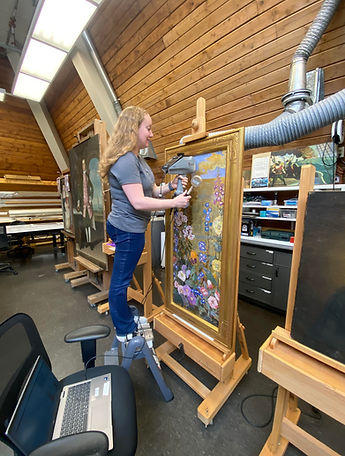

Using the Bruker ARTAX XRF instrument to collect data.
Image Credit: Catherine Matsen
Using the Bruker TRACER 5 portable XRF spectrometer to collect data of the silver colored leaf.
Image Credit: Catherine Matsen

Diagram of where XRF was collected. Spots labeled "XRF #" were taken with the Bruker ARTAX XRF instrument. Spots labeled "XRF HH #" were taken with the Bruker TRACER XRF spectrometer.
Paint/Gilding Color
Main Peaks
Possible Pigment/Metal
Bronze-Colored Leaf
Cu, Cr, Fe
Brass (Cu, Cr)
Gold-Colored Leaf
Au, Fe, Pb
Gold (Au)
Silver-Colored Leaf
Al, Fe, Pb
Aluminum (Al)
Pink Ground Layer**
Zn, Ba, Fe, Ca, S
Lithopone (Zn, Ba, S) with chalk
Blue Paint
Co, Cr, Cu, Pb
Sky Blue Paint
Co, Pb
Cobalt Blue (Co, Al)
Yellow Paint
Cd, Cr, Pb
Cadmium Yellow (Cd, S, Zn, Ba),
Chrome Yellow (Pb, Cr)
Orange Paint
Cd, Se, S
Cadmium Red (Cd, Se, S),
Cadmium Yellow (Cd, S)
Green Paint
Cr, Pb, Co, As
Chromium Oxide Green (Cr),
Viridian (Cr)
**All XRF results had peaks for Zn and Ba. It is believed that the ground layer peaks are being seen in all data.
Cross-Sections
To date, four cross-sections have been taken from the edges of the painting. Locations of cross-section samples can be found in the science proposal above.
All cross-sections will be analyzed with a digital microscope. This will confirm how Price applied the gilding to the painting. Cross-sections will also be utilized with scanning electron microscopy - energy-dispersive X-ray spectroscopy (SEM-EDS) and Raman spectroscopy.


PLM
This will be completed Spring 2026.
SEM-EDS
This will be completed Spring 2026.
FTIR
This will be completed Spring 2026.
Raman
This will be completed Spring 2026.
Conclusion
This will be completed Spring 2026.
References
Antiques & Fine Art Magazine. N.d. “M. Mary Elizabeth Price.” Accessed November 16, 2025. https://www.antiquesandfineart.com/artists/bio.cfm?id=482.
Atrei, A., F. Benetti, E. Gliozzo, G. Perra, and N. Marchettini. 2014. “Chemical Characterization of Protein Based Binders in Painting Samples by Means of ToF-SIMS: Tests on Ancient and Model Samples. International Journal of Mass Spectrometry 369 (August): 9-15. http://dx.doi.org/10.1016/j.ijms.2014.05.001.
Burgio, Lucia, and Thomas Gregory. 2021. “Protocol for the Analysis of Cross-Sections from Gilded Surfaces.” Heritage 4, no. 3 (September): 2416-2430. https://doi.org/10.3390/heritage4030136.
CAMEO (Conservation and Art Materials Encyclopedia Online). s.v. “Water Gilding.” Last modified June 26, 2022. https://cameo.mfa.org/wiki/Water_gilding.
Cathrine Martin Galleries. N.d. “Price, Mary Elizabeth.” Accessed November 16, 2025. https://www.catherinemartingalleries.com/current-catalog/list-by-category/paintings/item/775-price-mary-elizabeth-american-1877-1965-towpath-summer-along-the-delaware-river.
Centeno, Silvia A., Charlotte Hale, Federico Caro, Anna Cesaratto, Nobuko Shibayama, John Delaney, Katheryn Dooley, Geert van der Snickt, Koen Janssens, and Susan Alyson Stein. 2017. “Van Gogh’s Irises and Roses: The Contribution of Chemical Analyses and Imaging to the Assessment of Color Changes in the Red Lake Pigments.” Heritage Science 5, vol 18 (May): 1-11. https://doi.org/10.1186/s40494-017-0131-8.
Cretu, Cristian, and Elma van der Lingen. 1999. “Coloured Gold Alloys.” Gold Bulletin 32, no. 4 (September): 115-126. https://doi.org/10.1007/BF03214796.
Croll, Stuart. 2007. “Overview of Developments in the Paint Industry Since 1930.” In Modern Paints Uncovered: Proceedings from the Modern Paints Uncovered Symposium, edited by Thomas J. S. Learner, Patricia Smithen, Jay W. Krueger, and Michael R. Schilling, 17-29. Los Angeles: The Getty Conservation Institute.
DOYLE. N.d. “About DOYLE.” Accessed November 16, 2025. https://www.doyle.com/about/.
Jim’s of Lambertville. N.d. “M. Elizabeth Price (1877-1965).” Accessed November 16, 2025. https://jimsoflambertville.com/artist-biography.php?artistId=322868&artist=Mary%20Elizabeth%20Price.
Khandekar, Narayan, Carol Mancusi-Ungaro, Harry Cooper, Christina Rosenberger, Katherine Eremin, Kate Smith, Jens Stenger, and Dan Kirby. 2010. “A Technical Analysis of Three Paintings Attributed to Jackson Pollock.” Studies in Conservation 55, no. 3 (December): 204-215. https://www.jstor.org/stable/42751715.
Learner, Thomas J. S. 2007. “Modern Paints: Uncovering the Choices.” In Modern Paints Uncovered: Proceedings from the Modern Paints Uncovered Symposium, edited by Thomas J. S. Learner, Patricia Smithen, Jay W. Krueger, and Michael R. Schilling, 3-16. Los Angeles: The Getty Conservation Institute.
MacBeth, Rhona, and Caitlin Breare. 2021. “The Technical Examination and Documentation of Easel Paintings.” In Conservation of Easel Paintings, 302-321. Vol. 2. Edited by Joyce Hill Stoner and Rebecca Rushfield. London: Routledge.
Michener Art Museum. N.d. “Go Where Art Leads.” Accessed November 16, 2025. https://michenerartmuseum.org/about/mission-history/.
My Daily Art Display. N.d. “Mary Elizabeth Price.” Accessed November 16, 2025. https://mydailyartdisplay.uk/2025/03/09/mary-elizabeth-price/.
Pelagotti, Anna, Andrea Del Mastio, Alessia De Rosa, and Alessandro Piva. 2018. “Multispectral Imaging of Paintings.” IEEE Signal Processing Magazine 25, no. 4 (July): 27-36. https://doi.org/10.1109/MSP.2008.923095.
Perez, Miguel, Nathael Cano, Jose Luis Ruvalcaba-Sil, Alejandro Mitrani, and Oscar G. de Lucio. 2021. “Technial Non-Invasive Study of an 18th Century Novo-Hispanic Panel Painting.” Heritage 4, no. 4 (October): 3676-3696. https://doi.org/10.3390/heritage4040202.
Smithsonian. N.d. “Ferargil Galleries Records, Circa 1900-1963.” Accessed November 16, 2025. https://www.aaa.si.edu/collections/ferargil-galleries-records-8905.
Talbott, Page, and Patricia Tanis Sydney. 1998. The Philadelphia Ten: A Women’s Artist Group, 1917-1945. Galleries at Moore.
Teeter, Keara, and Catherine Matsen. 2018. “Technical Examination of Two (of the Seven) Edward Steichen In Exaltation of Flowers Murals Painted Between 1910-1914. Student report, Winterthur/University of Delaware Program in Art Conservation, May 2018. Electronic file.
Wetherall, Judith. 2025. Gilding Notes: The Traditional English Method. Los Angeles: Getty Conservation Institute.