Elizabeth Glander
2nd Year
WUDPAC
Supervised by Mina Porell
Associate Paintings Conservator for Winterthur Museum, Garden & Library,
Affiliated Associate Professor, Department of Art Conservation, University of Delaware


Condition Summary
Inscriptions & Labels
Verso
Upper stretcher member
Stenciled in black ink: "22-27"
Incised into the wood: "V [anchor symbol] S"
Lower stretcher member
Incised into the wood: "V [anchor symbol] S"
Lower center of canvas
Stenciled in black ink, upside down: "G R DODGE & CO / [illegilble] / SUPPLY STORE / ALTIMORE"
Frame Verso
Upper member
Printed in black ink on a label: "M. BARRETT & BRO. / CARVERS AND GILDERS, / 82 HOWARD STREE, corner of Saratoga, / [illegible] / MANUFACTURERS OF / Looking Glass, Portrait & Picture Frames. / AND GILT WORK IN ALL ITS VARIETY: / ALSO, / PLAIN 7 FA[illegible] / WOOD FRAMES, / AND IM[illegible] OF FRENCH AND GERMAN / LOOKING GLASS PLATES, / FINE ENGRAVINGS, &C. BOWEN & CO.PRS."
Conservation Records
No previous record of conservation exists, but there is evidence of previous treatment.
Auxiliary Support
The painting is stretched on an original four-membered wooden stretcher with slot mortise-and-tenon joints, and all eight keys are present.
Overall, the stretcher is stable and in good condition. There are abrasion marks at the center of each stretcher member, likely from nails and tools used to fit the painting into the frame multiple times. The lower right two keys are loose while the other six keys are secure. One of the keys in the upper left corner is much smaller than the rest. There is a thick layer of dust on the lower member of the stretcher as well as the four lower keys.
Primary Support
The primary support is a plain weave linen (est.). An average thread count is 13 threads/cm in the horizontal direction (est. warp). There is a colourmen’s stencil, in black ink, on the lower center half of the canvas. None of the edges have a selvage.
The lower tacking edge has extra pinholes associated with the priming of the canvas on a temporary strainer. These holes indicate that the prepared roll canvas was narrow (approximately 27.75 inches) and long. This caused primary cusping. When the canvas was attached to this strainer with tacks, secondary cusping occurred, which is revealed by the alternating black and white vertical areas in the x-ray radiograph.
The canvas is in fair condition. It is darkened and brittle due to the natural degradation of the cellulosic fibers. There are some canvas bulges in the lower left corner and along the lower left edge, seen in the raking light photograph. These likely result from the detachment of the lower tacking margin from the center seven tacks, which causes it to move freely. The tacks have corrosion products present resulting in staining of the canvas and fall out loss of canvas around the tack heads.
There are complete losses of the canvas along the fold over edges. It is possible that nails from the verso of the frame have caused many of these losses. There is impact damage above the sitter’s left shoulder, a small circular puncture that has been filled in the hair, an L-shaped tear in the outer sleeve of the sitter’s left arm, and a compound tear in the torso, which is are visible in the x-ray radiograph.
Preparatory Layers
The canvas was primed with a commercially applied, white, oil-based ground (est.) as indicated by the colourmen stamp on the back of the canvas. Based on the radiodensity of the ground in the x-radiograph and the date of the painting, lead white is the primary inorganic component of the ground. Both of the vertical tacking margins are primed all the way to the cut edge of the canvas, while no ground is present on the lower tacking margin. The ground application extends approximately 0.5-1 cm into the upper tacking margin. Infrared reflectography (IRR) imaging does reveal an infrared-absorbing preparatory drawing material in the eyes, nose, and mouth, in the 900-1700 nm range. It consists of thin lines, likely applied with a dry medium and a pointed tool, are visible. The eyelids were originally drawn covering more of the eye but then reworked to be more open.
The priming layer is well adhered to both the support and paint layers and is in good, stable condition overall. The tears in the primary support described above are associated with some losses in the ground layer. Tears and losses in the canvas can be clearly seen in the x-radiograph and will appear dark compared to lighter, more radiodense materials such as the lead white ground.
Paint Layer
The oil paint is thin and in many places the weave structure of the support canvas shows through. There are no visible brushstrokes in the background while there is fine brushwork within the figure. The white lace detail in the figure’s dress, as well as the details of the applique on the sleeve, has some low impasto. The background around the top of the figure’s head and right side of her body is slightly lighter suggesting that Bebie may have first painted the background with a lighter color and then darkened it after the figure had been blocked in but did not repaint all the way up to her.
There are inclusions in the paint, primarily above the figure’s head and on the right side in the background. The inclusions are round, soft-edged, and granular in shape. It is not known what these inclusions would be. A cross-section or a sample for analysis would need to be taken to help identify the inclusions.
The paint layer is in good condition. There are stress cracks throughout the entire painting, however, there is no lifting or flaking paint. These stress cracks likely result from mechanical stress due to fluctuating environmental conditions because where the frame covered the painting, there are less cracks compared to where the rest of the painting has been uncovered. There is some discolored inpainting and overpaint that corresponds to tears and areas of loss mentioned above
Coatings
The painting is currently coated with at least two coats of varnish. The top layer of varnish is estimated to be a synthetic varnish that was applied thinly with overlapping horizontal strokes made with a brush. With ultraviolet (UV) light examination, the surface has a blue-green fluorescence which is characteristic of a synthetic varnish. Below this is estimated to be a natural resin varnished. During a previous vanish application, it was decided to varnish around the figure. This application of varnish was not carefully done because there are areas of overlap on the edge of the figure.
The varnish has discolored. The corners of the painting that were covered by the frame fluoresce slightly differently than the rest of the painting. One possibility is that the frame protected the surface from pollutants and light which can cause degradation. UV light examination also reveals that someone had previously attempted to remove or reduce a previous natural resin varnish layer.

Condition map of the painting, recto.
Red = Area of loss
Orange = Abrasion
Yellow = Tear Light
Green = Inpainting/over painting
Dark Green = Insert and over paint
Light Blue = Cusping
Pink = Impact damage
White = Possible inclusions in the paint layer that are small and rounded

Condition map of the painting, verso.
Orange = Abrasion
Light Blue = Fill
Light Green = Felt adhered to stretcher
Purple = Adhesive and felt residue from being removed
Hans Heinrich "Henry" Bebie (c. 1799-1888)
The artist of this painting is Hans Heinrich “Henry” Bebie. While the exact date of Bebie’s birth is unknown, many sources believe he was born in Zürich, Switzerland in 1799 (Merrill 1997, 12; Winterthur Museum, Garden & Library 2025). There is limited information pertaining to Bebie’s life in general. For example, it is unknown if Bebie was a self-taught painter or he received formal training before immigrating to the United States (Winterthur Museum, Garden & Library 2025). Bebie was in Richmond, Virginia in 1842 (Merrill 1997, 12) before arriving in Baltimore shortly thereafter (Maryland Center for History and Culture 1956, 2).
In 1849, Bebie showed three paintings at the Maryland Historical Society’ Second Annual Exhibition. In the 1870s, Bebie was best known for his upscale brothel interiors and portraits of Baltimore’s wealthy, white families (Winterthur Museum, Garden & Library 2025).
Near the end of his life in 1888, he was listed in the Baltimore City Directory as “Bebie Henry, 805 n Calvert” but he was not listed as an artist or portrait painter in the appendix in the back (Sheriff 1888, 110). He may have retired from painting before dying on June 1, 1888 in Baltimore, Maryland (Maryland State Archives 2025).
Losses in the Canvas
Because the painting has not been removed from its stretcher, I will not to remove it from the stretcher to reinforce losses in the canvas.
There are two holes near the upper left corner on the turn over edge. To reinforce them, BEVA film coated PeCap was slipped in between the canvas and the stretcher. The photos below demonstrate how this was completed.
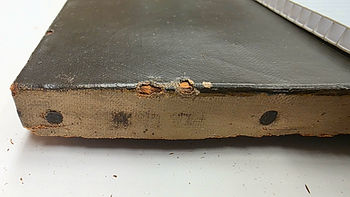
Losses before treatment.

PeCab fabric with BEVA film applied to it. Black linen carpet thread had been sewn through the bottom.

Using the carpet thread to pull the PeCap fabric into place.

Using thin wire to pull linen carpet thread in between the tacking margin and stretcher.

Using thin wire to pull the linen carpet thread through the holes in the canvas.

After the PeCap had been positioned. It was set with a heated spatula.

Losses after treatment.
Solubility Testing
Solubility testing was completed to determine the best way for removing surface grime. Initially, deionized (DI) water and then saliva with a DI water clear was used. Grime was not removed with either of these. The Modular Cleaning Program (MCP) was then used. It was determined that a pH 8.5 solution of citric acid, bicine, and DI water (1:1:3) removed surface grime. Two small sections of the painting was cleaned to perform varnish solubility testing.
Solubility testing was completed to determine the best way for removing varnish. Testing began with 1:3 isopropanol:ShellSol D38 solution and continued to 3:1 isopropanol:ShellShol D38 solution. The varnish was not removed and testing continued to solutions of acetone and ShellSol D38. 2:1 acetone:ShellSol D38 successfully removed the varnish.

Solubility testing for varnish removal.

Solubility testing for varnish removal.
Stabilizing the Lower Tacking Margin
Thread-by-Thread Tear Mending & Edge Lining
The lower tacking margin had become detached from the stretcher and there were three losses in the canvas. The ideal situation is to not unstretch the entire painting, but to just remove the lower stretcher member to stabilize the tacking margin. To stabilize the tacking margin, I would use inserts and connect them to the canvas using a thread-by-thread technique and then edge line the the tacking margin.
A temporary member was created using Coroplast, Volara, and Tycore board. Hot glue was used to attach the elements together. The temporary member was secured to the stretcher with screws.
Placement of the temporary member was determined partially where backing board screws would be placed. This is because I wanted to limit how many holes I was creating in the stretcher.

Both images are showing the temporary member.


The canvas is quiet brittle meaning I could not pull back the taking margin to remove the lower stretcher member. After tacks had been removed, a humidity chamber was created using Mylar, a damp blotter, and weights. Every five minutes the flexibility of the canvas was checked and after fifteen minutes, the humidity chamber was removed.
Humidity chamber to help relax the canvas of the lower taking margin.
Mina assisted me in removing the the lower stretcher member. First I tried to gently pull the member away with my hands, however, this did not work. I placed a piece of blotter board on the member and then gently tapped the area with a hammer. Once the stretcher member was removed, most of the dust and insect remains were removed with a soft bristle brush and a HEPA vacuum.
A dry blotter board was placed on the tacking margin while it dried. I did not want the tacking margin to be completely opened. I placed a piece of Coroplast next to the tacking margin so that the blotter board could not fully open up the tacking margin. The tacking margin was allowed to dry for about 24 hours.

Stretcher member removed, before removing dust and insect remains.

Blotter covering the tacking margin was it dries.
To address the three losses on the turnover edge, I used a thread-by-thread tear mending technique referred to as the "beetle" technique. Petra Demuth created this method of applying a canvas insert to a loss based off of Winfried Heiber's thread-by-thread tear mending technique.
With this technique, a new piece of canvas with a similar thread count is decrimped three times and sized with 8% methyl cellulose. It is then cut to be larger than the loss in the painting. Excess threads are removed until the shape of the insert matches the loss. The insert is positioned in the loss and every other thread is positioned on either side of the painting.
I began to attached the new threads from the back of the painting using 9:1 Lineco:5% methyl cellulose adhesive. Every other thread was adhered to the canvas. It is important that the ends of these threads are not in a straight line with each other to reduce stresses to the canvas. The remaining threads were cut and attached to the original canvas using a butt joint.


Steps used for the "beetle" technique for an insert.
References
“Archives of Maryland, Volume 0565, Page 0457 - Matchett’s Baltimore Director for 1855-56.” Accessed March 11, 2025. https://msa.maryland.gov/megafile/msa/speccol/sc2900/sc2908/000001/000565/html/am565--457.html.
Fair, Lauren, Mary McGinn, and Lisa Clifford. 2025 (updated). “Winterthur X-ray Procedure Manual: User guide for Winterthur’s Pantak-Seifert X-ray equipment and Rhythm software.”
Hellier, Henry R. 1863. “E. M. Cross & Co.’s Baltimore City Business Directory, 1863-1864.” Baltimore: E. M. Cross & Co.
John W. Woods. 1860. “Woods’ Baltimore City Directory, Containing a Corrected Engraved Map of the City, a Business Directory, a Street Directory, Compiled expressly for this Edition; and an Appendix of Much Useful Information.” Baltimore: John W. Woods. https://archive.org/details/woodsbaltimoreci1860balt/page/n75/mode/2up.
Karraker, D. Gene. 2009. Looking at European Frames: A Guide to Terms, Styles, and Techniques. Los Angeles: The J. Paul Getty Museum.
Katlan, Alexander W. 1987. American Artists’ Materials Suppliers Directory, Nineteenth Century. Park Ridge, New Jersy: Noyes Press.
Katlan, Alexander W. 1992. American Artists’ Materials: A Guide to Stretchers, Panels, Millboards, and Stencil Marks. Vol. 2. Madison, Connecticut: Sound View Press.
Maryland Center for History and Culture. 1956. “Henry Bebie (Hans Heinrich Bebie) 1800?-1888: Portrait and Genre Painter of Baltimore.” Registration Files, Maryland Center for History and Culture.
Maryland State Archives. 2025. “Matchett’s Baltimore Director For 1855-56.” Accessed March 11, 2025. https://msa.maryland.gov/megafile/msa/speccol/sc2900/sc2908/000001/000565/html/am565--457.html.
Maryland State Archives. “Information on CE42 – (Death Record, Index).” Accessed March 11, 2025. https://guide.msa.maryland.gov/pages/series.aspx?action=viewSeries&ID=CE42.
Matchett, Richard J. 1851. “Matchett’s Baltimore Director for 1851, containing the Names, Dwellings and Occupations of the Householders, an Engraved Map of the City, Designating the Wards, with References to Public Buildings.” Baltimore: Richard J. Matchett. https://archive.org/details/matchettsbaltimo1851balt/page/n13/mode/2up.
Merrill, Peter C. 1997. “German Immigrant Artists in America: A Biographical Dictionary.” Lanham: The Scarecrow Press, Inc.
Sheriff, B. R. 1888. “R. L. Polk & Co’s Baltimore City Directory for 1888.” Baltimore: R. L. Polk & Co. https://archive.org/details/rlpolkcosbaltimo1888rlpo/page/n29/mode/2up.
The Baltimore Sun. “Article Clipped from The Baltimore Sun.” June 2, 1956. https://www.newspapers.com/article/the-baltimore-sun/50099375/.
Winterthur Library. 2005. “2005.0192, Looking Glass.” Winterthur Decorative Arts Photographic Collection Online Resource. Last revised June 23, 2005.
Winterthur Decorative Arts Photographic Collection Online Resource. “SeeDAPC Index.” Accessed March 6, 2025. http://dapc.winterthur.org/iseedapc/obj_dat/2005.0192.htm.
Winterthur Museum, Garden & Library. 2025. “2024.0019 A, Painting (Portrait).” Search the Winterthur Museum Collections. Last updated April 28, 2025Accessed March 10, 2025. http://museumcollection.winterthur.org/single-record.php?resultsperpage=20&view=catalog&srchtype=advanced&hasImage=&ObjObjectName=&CreOrigin=NOrth%20America&Earliest=&Latest=&CreCreatorLocal_tab=&materialsearch=&ObjObjectID=&ObjCategory=&DesMaterial_tab=&DesTechnique_tab=&AccCreditLineLocal=&CreMarkSignature=&recid=2024.0019%20A&srchfld=&srchtxt=&id=9bfa&rownum=44281&version=100&src=results-imagelink.
Wood, John W. 1870. “Woods’s Baltimore City Directory, Containing a Corrected Engraved Map of the City, a Business Directory, a Street Directory, and an Appendix of much Useful Information.” Baltimore: John W. Woods. https://archive.org/details/woodsbaltimoreci1870balt/page/774/mode/2up.
Young, Christina, and Alexander W. Katlan. 2021. “History of fabric supports.” In Conservation of Easel Paintings, 117-147. Joyce Hill Stoner and Rebecca Rushfield, eds. 2nd ed. New York: Routledge.